
GIVEN the honour by the governors of the Aberdare Boys’ Grammar School of being chief speaker at the annual ‘Speech Day’ in the Coliseum on Thursday, Mr. T.J. Lewis,1 newly retired from the win posts of Divisional Education Officer and Clerk to the governors, made a happy reciprocal gesture by delivering an interesting and stimulating address in which he reviewed the new era which is opening in education and spoke of the responsibilities of the future.
Mrs. Lewis2 was given the honour presenting the successful boys with their school certificates.
Mr. Lewis, given an ovation, mentioned changes in the educational set-up forecast by the Deputy Director of Education for Glamorgan (Mr. Trevor Jenkins,3 a Cwmaman boy), and went on to say that whatever the school was called under the new regime, it would probably continue to be affectionately known locally—especially by those who had been pupils—as the county school.
Not having had the distinction of being even a pupil there, as Mr. Jenkins, and Mr. Gordon James,4 the new town clerk, both among the guests of honour on the platform, had been, he felt deeply honoured to have been chosen chief speaker that day. It was a privilege, he felt, to address boys and parents on such an important day.
SCHOOL’S GOOD TONE
He was glad to see the school going from strength to strength. The successes registered year after year threw great credit on the teaching staff. These and other successes in sport, etc., said much for the tone of the school.
Turning to face the guests on the stage and then turning to the boys in the auditorium again, Mr. Lewis said “This is a day when I can definitely say that I have the governors behind me! You will not appreciate the full force of that little joke, perhaps, but speaking seriously I can tell you this: the men and women sitting behind me here are tremendously keen about education and prepared to give their time freely for it.”
“You may ask us of the older generation what right we have to tell you how to govern your lives when our generation has made such a mess of things,” he went on. “There would be a certain amount of validity in the criticism and I am prepared to accept it—if you, on your side, will accept your responsibility for the future in the words and spirit of the song you sang earlier—‘I vow to thee my country’.”
OUT OF WASTE LAND
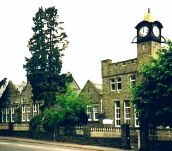
Commenting that the older generation “were not all that bad,” Mr. Lewis pointed out how, in building the school the “fathers” had converted a piece of waste land into a place of learning for the common good. They had not built a palace (Mr. Ambrose, the headmaster, had earlier on said it was almost graduating into an ancient monument!), but they had created a place which was more than mere bricks and mortar—a place served by able men dedicated to the task of making good men who could serve the community better.
The excellent way the school had done its work was shown by the crowded university and college scholarship signboards in the main hall, which indeed, bore so many names that it was difficult to believe that the school had existed only 50 years or so.
Since the “fathers” first thought of a county school, things had changed immensely. Whereas, for years, we had been talking of “the educational ladder,” we now spoke of “the broad highway of education.” Any child starting in the primary school today, possessing ability to make the most of the opportunities provided, could progress educationally to the topmost peaks of knowledge—with the full support of the County education authority or the State at every step.
Wales had an undying faith in education and Britain generally knew that the quality and security of our of our democracy—government of the people, for the people, by the people—was based on an adequate system of education. It was education that enabled people to express themselves, and in a democracy that was important.
However, education, of itself, was not enough; it could teach us how to control the group forces of Nature, but education alone could never teach us to control and curb ourselves—and what a tragedy it would be if, with all the scientific knowledge we possessed in this country, we used it only for destructive purposes!
“The world is in great need of educated men, but it is in even greater need of WISE men who consider facts and whose wisdom is allied to goodness,” said Mr. Lewis. “It was only when wisdom was allied to goodness that we found “a wise man made perfect.”
Education could give men power, but unless this power was used in the service of mankind, there was every cause for sadness.
Mr. Lewis, who is now taking an active interest in the Aberdare Educational Settlement, added “I think that one of the finest features of our public schools is the settlement work which has been done. It was in this way that Mr. Attlee learned that there was another side to life.”
Mr. Lewis paid a sincere tribute to Ald. (Mrs.) F. Rose Davies, M.B.E., J.P. (chairman of the governors), whom he described as “one of the greatest friends of the school,” and to Mr. E. Stonelake, J.P. “another close and intimate friend of the school.”
Mr. Trevor Jenkins, speaking as a Cwmaman ‘boy’ of Mr. Lewis (who also came from that district), said he had known the value of Mr. Lewis—first as a teacher. at Cwmaman and later as a very able fellow administrator. He considered that the gesture of the governors in inviting Mr. and Mrs. Lewis there that afternoon as chief guests, was a most happy one.
Today, in these areas, we were seeing new avenues being opened for the young people in the schools. Some of the pupils leaving the County School this year had taken up engineering.
Aberdare had always lacked a place where there was whole time training to meet the technical needs of the community. This was because, until recently, there was no need in Aberdare for technical education outside the mining industry.
But the industrial make-up of South Wales had changed and local authorities were now being called on to meet new demands in the educational field. The College of Further Education now in course of erection here was a revolutionary step forward as far this town was concerned.
Mr. Jenkins finally expressed the hope that there would be a close liaison between the grammar schools and the College.