
Aberdare Boys’ Grammar School
Miscellaneous
A Photographic Portrait of Sir Henry Jones
sent via Mark Jefferies
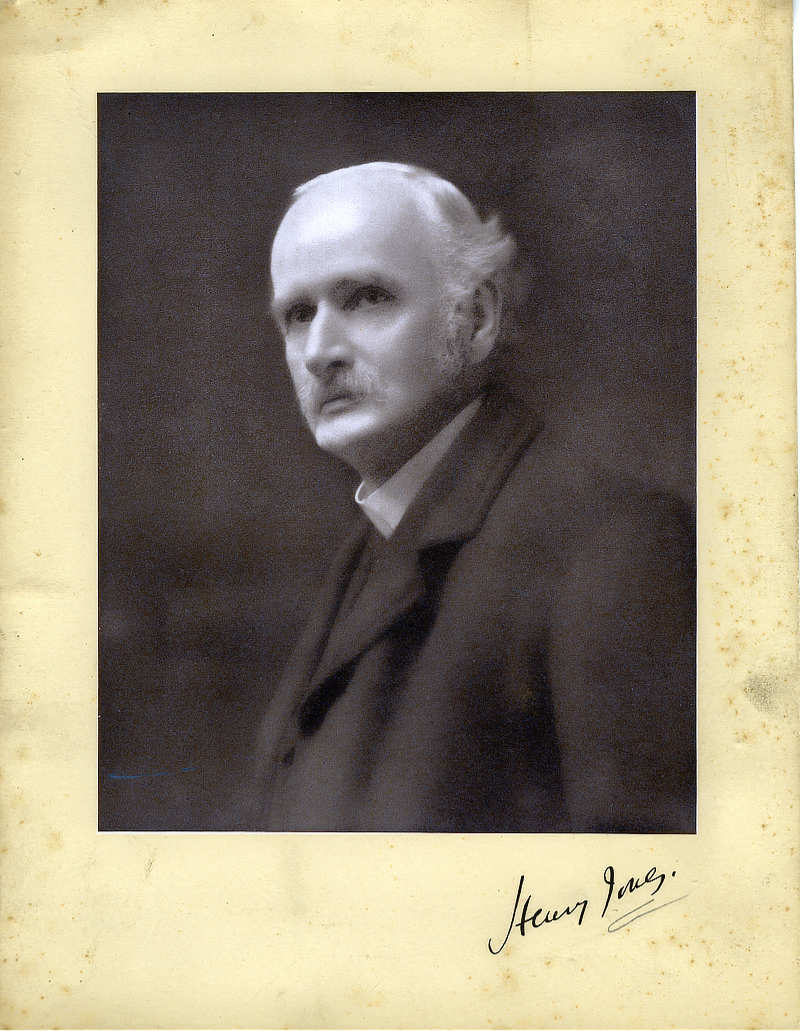
Professor Sir Henry Jones.
When the Aberdare Boys’ Comprehensive School was in its last few weeks of existence before its closure prior to its demolition, efforts were made to find and preserve many of the items held in various places scattered about the building. Miscellaneous items had been kept by several headmasters dating back to the early 1900s – many of these artefacts have made their way onto this website.
One such item is a photographic portrait of a man by the name of Henry Jones. It was soon ascertained that the man was Sir Henry Jones, a professor at Glasgow University. But, how did such a photograph find its way into the school’s archives.
One theory goes as follows. The first headmaster of the school was William Jenkin Thomas a 26-year-old from Merionethshire. After attending Friars School in Bangor, he went to Cambridge in 1888 and graduated in Classics. Immediately following Cambridge, he was appointed to a lectureship at the university in Bangor. He was there from 1891 until he left for Aberdare in 1896.
Also on the staff at Bangor was an academic from Denbighshire named Henry Jones. He was Professor of Philosophy and Political Economy having been appointed in 1884. He left Bangor at some point during 1891 having been appointed Professor of Logic, Rhetoric, and Metaphysics at the University of St Andrews. In 1894, he moved again to become Professor of Moral Philosophy at the University of Glasgow, where he remained until his death in 1922.
It’s possible that William Jenkin Thomas and Henry Jones met briefly in Bangor during 1891. In those days, the staff numbers were very small*, and it is possible that the two men would have known each other from interactions in the senior common room during Jenkin Thomas’s appointment process or soon after.
It may be that when Jones was knighted in 1912, or on his appointment as Companion of Honour, C.H., in 1922, he sent his former colleague the photographic portrait. We’ll probably never know whether this was the case.
*When Bangor opened as a University in 1884 there were just 58 students and ten members of staff. By 1890,
the student numbers had increased to around 600, with proportionately about 100 staff members — still small enough for staff to know each other.